Never Sleeps

While a pastor on the Fort Berthold Reservation I was honored with the Indian name, "NeverSleeps". It was primarily because I was often responding to particular needs in the middle of the night.

Even more relevant, the Lord Himself, Maker of all, "Never Sleeps".

Surely you know.
Surely you have heard.
The Lord is the God who lives forever,
who created all the world.
He does not become tired or need to rest.
No one can understand how great his wisdom is.

Isaiah 40:28

Welcome to every reader. I am a simple follower of Jesus. He is perfect, I often fall short.

Friday, August 16, 2019


Image result for seeing with new eyes
New Life, New Eyes

Jesus replied to him, “Truly, I tell you emphatically, unless a person is born from above he cannot see the kingdom of God.” John 3:3

Nicodemus was a Pharisee. If you are acquainted with Christianity or the New Testament, the term Pharisee may conjure images of hypocritical, demanding and arrogant religious men. And, for many of them, that would be appropriate. But there were some of these religious scholars who went deeper than the veneer of religious practice. Indeed, most of them obeyed so many rules because they wanted to be close to God. But, setting up rules to measure one’s divine acceptance causes two problems.

First, it creates an elitist mentality. If you are able to follow more rules than someone else, you are therefore closer to God. Live by these rules long enough and you will begin to emphasize the ones that are easiest for you to follow, and conveniently forget those you have ignored. You become a judge of all who do not follow your rules so well. You divide people into those who truly want to follow God, and those who are simply lukewarm; all based on your judgment of their response to the rules you emphasize.

Second, if you are a more self-aware Pharisee, it can create self-condemnation and loathing. You also are able to follow quite a number of the rules, but you discover your inner life to be dead. You are unable to follow all the rules well, but since they are the measure of your worth, you judge yourself as weak, uncommitted and lacking in religious zeal. You don’t judge others, you judge yourself, to your detriment. You may seek out someone who can help you solve the aching in your soul.

I think Nicodemus falls into this category. He approaches Jesus one night and starts with a bit of flattery: “Teacher, we know that you have come from God. No one could perform the miracles you do unless God was with him.” (John 3:2) Maybe it is not entirely flattery; I think Nicodemus is voicing what he has mused in his heart. “This Jesus intrigues me. The miracles are real. He speaks with authority. But he is so unlike what I imagine a religious leader to be.”

Much is made of Nicodemus approaching Jesus at night. Sure, maybe he didn’t want his fellow righteous dudes to know he was there. But let’s give Nic a break; he’s the only one who actually asked Jesus for a hearing. And, unlike the later attempts of others to trap Jesus with their questions, Nicodemus appears to sincerely desire answers.

Even though Jesus deflects the flattery, it seems he observes at least some sincerity in Nicodemus’ approach. Jesus says, “Truly, I tell you emphatically, unless a person is born from above he cannot see the kingdom of God.”

Nicodemus is taken aback, hearing Jesus quite literally. He wonders, “How can a person be born when he is old? He can’t go back into his mother’s womb a second time and be born, can he?” (Side note, his mother would be “older” than he was.)

Though it sounds mysterious, and it certainly took Nicodemus aback, I think Jesus’ answer is fairly simple. The Kingdom of God is spiritual in nature. Not “spiritual” as opposed to “natural” because all of creation is God’s world. But spiritual as above natural. The Kingdom of God exists invisibly above (in the sense of ruling over) the natural realm or the regimes of this earth. Just as we “see” the earthly regimes with physical eyes, we must have spiritual perception to see the Kingdom of God.

Just as we are born by physical parents and experience physical reality, we need a new and different kind of birth to recognize God’s kingdom. This verse has little to do with "going to heaven after I die." It is so much more than that. Unfortunately, the phrase "born-again Christian" has reduced it to an elitist saying which divides one kind of Christian from another.

Jesus was expressing a simple truth about how we experience the Rule of God in this world. We do indeed need a "rebirth" to experience this. But Jesus makes clear that He came in love so that whoever believes in Him should have "eternal life". (Just 13 verse later.) God's kingdom is full of reborn folks who have believed and trusted in Jesus. Don't narrow that down to a certain kind of "sinner's prayer" or "coming to an altar". Indeed, Jesus doesn’t even offer to pray with Nicodemus to be “born again.”

I have seen this beautiful transition from an earthly view to heavenly transform and enlighten many people’s lives. But I have also seen it turn into another set of rules. We may begin joyfully, expecting to walk in love and compassion (the hallmarks of God’s kingdom), but eventually we start adding our rules. You must be against all abortions, and you must call every abortion “murder”. If you are a baker, you must not make wedding cakes for gay marriages. You must never work on Sundays. You must vote Republican and must hate Democrats. (I’ve heard lifelong “born again” Christians say out loud, “I hate Nancy Pelosi”, the current Speaker of the House. I’ve heard “born again” preachers declare Obama was the Anti-Christ.)

I used to be among those who thought my “born again” status meant I had to identify with the “far right”. No longer. Having read the Bible independently now for over 40 years, I see Jesus emphasizing “the least of these” as he names the marginalized people among His time. I hear God calling over and over again for His people to love mercy, to practice compassion, to demand justice for the poor, the widow, the immigrant and foreigner.

In other words, I have begun to see God’s Kingdom as far more inclusive than I once thought and was taught. It is simply trusting Jesus that enables me to be “born from above”. And the way I keep growing in the life is to keep trusting Him, knowing Him. Sometimes knowing Him aligns me with my old tribe, but quite often as I see His kingdom, much of very conservative Christianity looks more like Nicodemus’ peers than Jesus.

I have a lot of growing to do, so I pray the Spirit will continue to enliven within me that which is truly spirit, that which is truly the Kingdom of God.

There is transformation, enlightenment, change of view when we experience a new birth. It changes everything. And, please remember, Jesus wasn't talking to a lowdown sinner when he said this; he was talking to a big-time religious leader!


Thursday, August 15, 2019

Pay to Enter


Pay to Enter


(“And he ordered those who sold the pigeons, ‘Take them out of here! Stop making my Father's house a marketplace!’” John 2:16)

Pay to enter; the school, the church.
Pay to play; the immigrant, the poor.
How much money can you make,
What are your assets to insure your entrance?

Who retouched the photos of God with their own portraits?
Who erected the fence around the altar?
Who sold access to the highest bidder?
Who bartered the sun and the rain?

When did you ever receive a bill for your breath,
a charge for the breeze? When deposit did you pay
to see the dawn, what fee to enjoy the grass between your toes?

And now you auction the Painter’s works that you enjoy for free?
You save your glitter for the best of these and
ration your mud to the least.
You do as you please while the Artist opens the studio windows wide,
the cross-breeze brushing each cheek extravagantly.

Play upon the good earth; the rose, the dandelion.
Enter without pay; the festival, the fire.
How much money would it take
to buy the love that covers the world with
its own resemblance.

Paint on my eyeballs Your perfect image;
deeper than the canvas, higher than the circle of this earth,
broader than borders. Script upon my ears
the song that banishes walls, that is purer
and more fearsome than repeated phrases
shouted at rallies to keep the rabble away.

I will not raffle the Handiwork of the Beloved.

Monday, August 12, 2019

To Go Home


To Go Home


(“This is he of whom I said, after me comes a man who went before me, because he was before me.” John 1:30)

So you saw him eye-to-eye
and jumped in the womb when his
mother came calling.

You saw the spirit land
like a dove on his shoulder
and heard a voice announce his call.

You baptized him,
and wondered,
wishing it was his hand upon your head
that lay beneath the waters.

So you touched him skin-to-skin
and did resist his righteous request.
You leveled the earth before the lamb,
the world’s sin-eraser,
and got yourself in trouble with
politicians and kings.

Me, I feel stranded here,
moored upon earth in a square-foot perimeter.
Me, I’ve landed here without seeing,
without touching,
without knowing a heartbeat within my own,
an uncancelled thought, a ghost of a holy touch
on my wrinkled brow.

I write from emptiness, a well dry as crust,
a heart of tears so salty they are dust upon my cheeks.

I cry out, I appease to empty space above and within.

You saw him eye-to-eye,

Me, I’m just waiting to go home.

Friday, August 9, 2019

A Single Honest Sentence


A Single Honest Sentence

(“And he said to me: ‘This is the word of the Lord to Zerubbabel, saying: Not by might nor by power, but by My Spirit, says the Lord of Hosts.” Zechariah 4:6)

The rooms were dusty July, places where camp-meetings echoed past the hills.
The children came, like summers do, sent for a week to seek
for God and friends and girls and boys. Children,
with minds so plastic even the heat could change their opinions.

Preteens with whirling energy that turned the forest into a cross-country race,
and the basketball court into dodge ball. Debates flared on the putt-putt course
over water hazards left there by the rain. The oldest got to hit their balls again.

Mornings were slow. Lunch was just the fuel stop for an afternoon of
crab races, water balloon bazookas with multi-colored projectiles threatening
from every direction. The lucky ones were drenched early and sent back to their
cabins to change. The grass grew best where weeks of water bombs watered the field.

Preteen boys who insisted they did not sweat were handed deodorant sticks for free.
Puberty stinks and adults cannot forget old sweat and new bacteria.

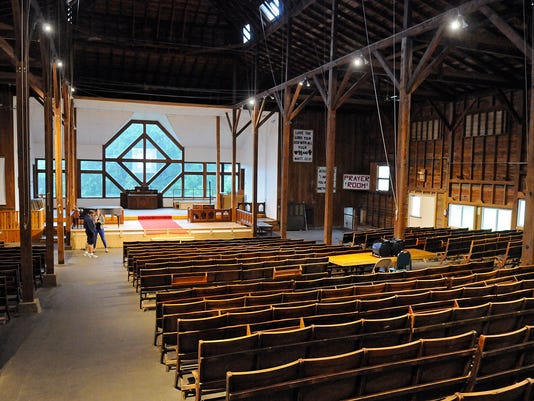
But nighttime was the purpose, the focus, the target. After supper, near 6:30,
300 children crowded into the wooden tabernacle without air conditioning,
without insulation. An ancient shell with rafters swooping to the sky the color
of dried fences on the farm.

Rock music was piped in, the children shuffled from one row to the next.
Counselors sought vainly for the one camper missing from their group.
Each night was planned for maximum effect, to bring decisions.

Decision.

And some decided; to be nicer at home, to not talk back, to do their homework
more often: all summed up in giving their life to Christ. And sincere as children
are, they bought the line (which is just fine) and many trace the joy, the grace,
to one of these times.

The final night was full of expectation. It was Holy Ghost night. If you are
pentecostal, you say it all as one word: “holyghost”.

It is true the Spirit of the Living God will dwell in us, will speak to us, will entreat us
too. But the Spirit rarely bowls us over or transforms a boy who has 15 people
shouting in his ear.

I was there and loved the sweet aroma of children discovering God’s Spirit
like butterflies finding nectar. But the perfume was mixed with the latest
spirit-will-make-you-do-it fads.

And 30 years later I have to explain to some who felt defrauded, deceived and
prodded, that I’m sorry. I was a product of the times. Today I know the Spirit
so differently. And so today I quietly listen to a child speak, and know

There is more power in a single honest sentence from a twelve-year-old
than all the shouting in temples and tabernacles around the world.

Thursday, August 8, 2019

Crumbs Become


Jar of Flour

Crumbs Become
(“The two then explained to them what had happened on the road, and how they had recognized the Lord when he broke the bread.” Luke 24:35)

The crust shines amber, simple, steaming, sensual;
the bread once grains, once wheat, once seeds, once wheat again,
awaits the gathered few who have talked the whole road trip long.

The conversations are doubt and wonder,
and long pauses where only the breeze spoke and
opened their hearts.

Sometimes traveling is holy, sometimes it is pilgrimage,
sometimes it is communion, and sometimes it starts as
grief and ends with astonishment. And other times it is
merely the morning commute.

But, recognize it or not, the spaces between us are occupied
by the God who suffers and lives among us. Walking beside
us, stopping between us, days after we thought he was gone
for good.

For our good he suffers, for our hope he slays the monster of death
by his own forbidden way; dying to win. Within the tectonic plates
below our feet and the pulsars exploding above us, outside our perceptions
but closer than the pores on our faces, earth is tied to heaven
in the breaking of the bread.

The day ends slowly, dusk is golden, acquaintances become friends
and extend the invitation to share a meal before separating.
Then the stranger takes the bread like the host of the house,
the weight of dough kneaded by daily labor rests in his hands.
The sun, the earth, the seed, the grain, the ox, the millstone,
the fire and the baker have all conspired to meet at this small table;
an altar in the world.

Breaking it; the aroma fills the room. All is bread once the bread is broken;
salivating, the mouth prepares for ordinary provision.
Blessing it; the necessary response of earth-dwellers who
depend upon heaven.

And in the breaking, the blessing, benediction; in the simple meal
on the earth so full of soil and mud,
we see Christ, our eyes are opened, and crumbs become a
cathedral for those who have seen.

Tuesday, August 6, 2019

Words to Melody


Scaly Breasted Wren from Ecuador Credit: Nick Athanas/Flickr/Creative Commons
Words to Melody


(“The Lord your God is in your midst—a warrior bringing victory. He will create calm with his love; he will rejoice over you with singing.” Zephaniah 3:17)

Sing me the lyrics I cannot remember. Sing me the song in the trees.
I need a lullaby, wind and violins to open the heavy coal mine that
occupies my soul.

The weight of the atmosphere keeps the leaves from whistling,
my heart from joining words to melody,
The weight of the atmosphere only reminds me of
what I cannot recall, what refuses to be resolved.

Sing me to life with wordless breath. The soundtrack of pain
is set so high the butterflies rise upon its updraft and escape across
the backyard fence. All I want is calm and rest,

And yet the silence infests me with neurons that buzz like
high voltage lines. My mind is crushed, the cranium shrunk by
abbreviated muscles and nerves. On the verge of leaving every
question behind, the pressure surges; a sound dull and slower than
my heartbeat; louder than the noonday sun.

Sing me to hope with your hands and face. Sing me to hope,
sit beside me in grace. Sing me to hope, cry with me. Sing me
to hope and remember our childhood joy and wonder.

All I remember are images, pixels scattered like jigsaw puzzles.
Sing me the words that patch the cracks, that take me into
magical forests, blue jay fun, dolphin joy and a sun that
revives-not-scorches.

Sing me the words on covered front porches where friends from
forever, renewed and amended, will remind me of the lyrics
that abandoned me here.

Monday, July 1, 2019

Come and Go


An old-fashioned swimming hole
Come and Go

Some days come and go,
and others are slow like the
local swimming hole after all the children
have gone home.

There is no drifting, splashing or
tick-tocking to mark the ions of time.
Some days they all stand still, hovered just above
the memories after

All the children have gone home.

These are the places in my dreams,
the spaces between the buzzing summer when
thoughts were younger
and the approaching winter when
only the silence has much to say.

Some days drag and push,
and others rehearse memory
in slow motion like the schoolroom clock before
all the children have gone

Home.